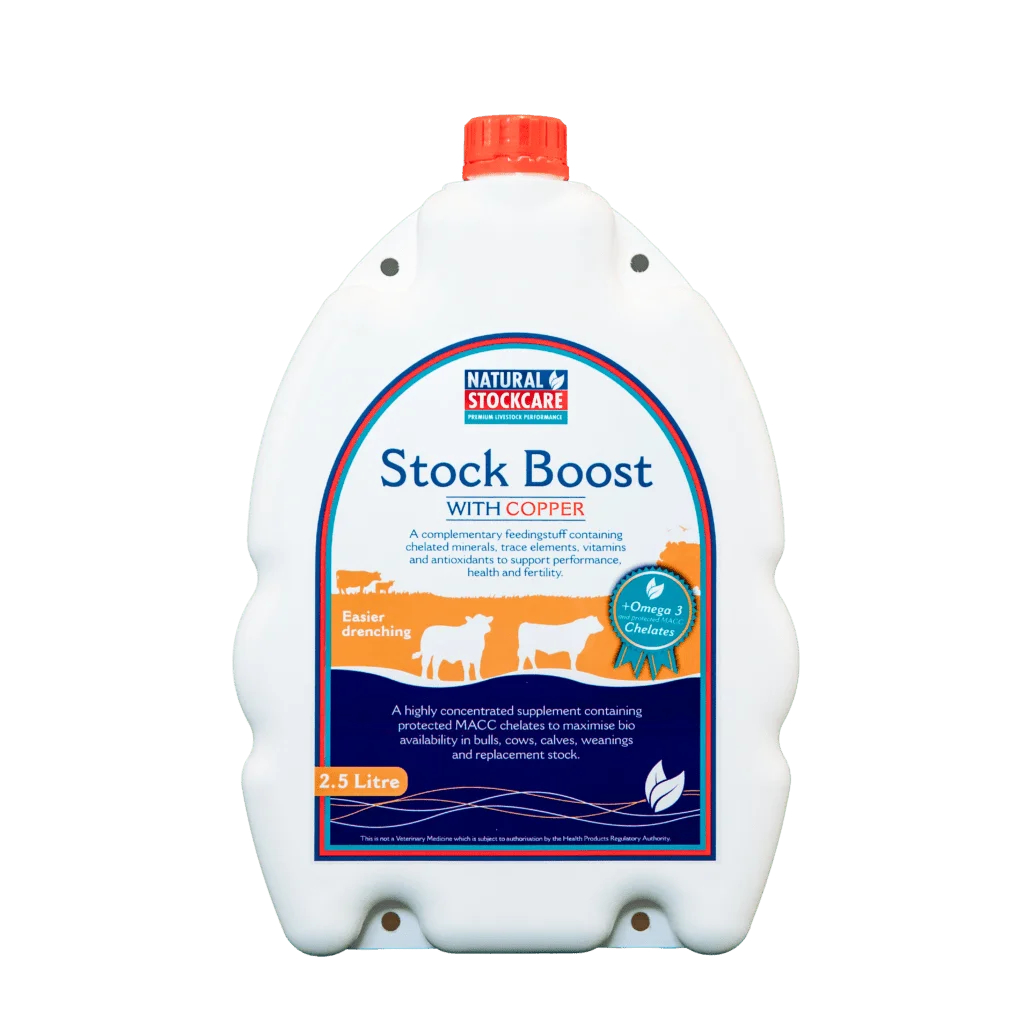
Stock Boost

A highly concentrated supplement containing protected MACC chelates to maximise bioavailability in bulls, cows, calves, weanlings and replacement stock.
Available sizes:
1 Ltr
2.5 Ltr
5 Ltr

Applications
Four weeks before mating or flushing

Ten days before calving

At drying off

Cows at times of stress: Difficult calving, housing, cows that need a tonic, after any veterinary treatment, drying off.

Calves: Two weeks after birth.

Do not repeat the application within seven days

  • 60mls at drying off and returns to service
  • 60mls 7-10 days pre-calving + 1-3 days post-calving
  • Returns to service:: 60mls / 2 drenches / 3-4 weeks apart
  • Embryo transfer: 60mls 3-4 weeks before flushing
  • Cattle/Calves: 5mls per 50kg bodyweight

Product Information

  • Stock Boost helps promote cattle fertility by addressing essential nutrient deficiencies, leading to healthier offspring, increased reproductive success, and improved animal health.
  • By delivering the precise blend of essential vitamins and trace elements, Stock Boost ensures your calves receive the nutrients they need to reach their full growth potential. As a result, with Stock Boost, you can witness remarkable weight gain, muscle development, and overall size improvements.
  • Offering comprehensive nutritional support during critical periods, such as pre-and post-transition, Stock Boost helps to promote optimal cattle health and performance, contributing to better productivity and profitability for farmers.
  • The unique formulation of Stock Boost is designed to correct vitamin and trace element deficiencies, supporting the animal’s immune system and aiding in fertility, helping to promote healthier calves and more successful breeding efforts.
  • Stock Boost is a versatile supplement that is particularly beneficial during times of increased nutritional demand, such as peak milk production, helping to maintain cattle health, performance, and fertility throughout their life cycle.
  • Combining chelated trace elements and essential vitamins, Stock Boost’s specialised formula helps to promote various aspects of cattle health, including fertility, colostrum quality, and overall well-being, contributing to a thriving herd.

Customer Testimonials

“Fertility levels have improved, with more cows scanning in calf.”


“We use Stock Boost on our youngstock — calves and bulling heifers — about 2 to 3 weeks after turnout. It gave us great peace of mind knowing they were thriving and getting the vitamins and minerals they require during this critical time.


I gave Stock Boost to my bulling heifers about 3 to 4 weeks before they started AI. It helped clear the browny tinge from their coats, and since using it, fertility levels have improved, with more cows scanning in calf.


During any stressful periods — vaccination, AI, housing — Stock Boost always provides that extra support when the animals need it most.”

— Tipperary

David Bergin

“A blanket dose ensures sufficient minerals and maximizes liveweight gain.”


“I recommend using Stock Boost on all young stock. They are often deficient in certain minerals, such as copper, when on a grass diet.


A blanket dose of Stock Boost in early summer ensures sufficient minerals in the diet, which in turn helps to maximize liveweight gain at grass. This can be seen in the coat of the animal, too.


It’s user-friendly compared to some other dosing products which can block up applicators.”

— Limerick

John Loughman

Technical Information

  • The vitamin needs of cattle can be confined mainly to A, D, and E. This is because bacteria in the rumen of cattle are considered able to synthesise vitamin K and B vitamins, usually in sufficient quantities to meet the animal’s requirement (Suttle, 2010). Specific supplementation with vitamins A, D, and E can be crucial for maximum growth and productivity for calves and adult cattle (Givens, 2009). Together, they control essential metabolic functions for feed conversion efficiency, average daily gain, productivity, and disease-free. The importance of these vitamins to the newborn calf is contrasted by the fact that they do not cross the placenta in high enough amounts to meet their requirements. Calves must obtain sufficient levels through colostrum right after they’re born. Therefore farmers should focus on the vitamin status of the cow before calving to ensure adequate levels of colostrum (Givens, 2009). Poor quality forage may also contribute to a decrease in the proper uptake of minerals and vitamins.
  • Vitamin A comes from the carotene in green and yellow plants, and shortages while on fodder are not uncommon (Givens, 2009). Vitamin A is a fat-soluble vitamin that plays a vital role in the immune system. Vitamin A is associated with maintaining the protective mucous membranes of the respiratory and digestive tracts (Underwood & Suttle, 1999). It is thought that a deficiency in vitamin A causes damage to these membranes, which allows bacteria and viruses an opportunity for invasion. In this regard, a vitamin A deficiency has the most profound and significant adverse effects on the immune system and the frequency of especially respiratory infections (Underwood & Suttle, 1999).
  • Vitamin D governs calcium metabolism, cellular activity in critical organs, muscle contraction, and metabolic processes (Goff, 2010). In addition, vitamin D is essential to the health of bones and the digestive tract. A deficiency predisposes hypocalcaemia, osteomalacia (bone softening), immunosuppression, and acute organ failure (Goff, 2010).
  • Vitamin E is a vital antioxidant that protects the body from cellular damage and breakdown (McDowell, 2000). Likewise, Vitamin E is essential in protecting body cells from damage (e.g., from infections) and also plays a role in maintaining immunity. The result of deficiencies in these vitamins can show up as decreased vigour and increased susceptibility to illness (McDowell, 2000).
  • Copper, Cobalt, Manganese, Iodine, Selenium, & Zinc all play crucial roles in immunity development, freedom from disease, fertility, growth, appetite, skin, bone growth, and muscle development (Suttle, 2010). They are crucial for the foetus in utero and the newborn calf. Pregnant animals and animals exposed to physiological stresses should be routinely supplemented with these critical minerals (Hostetler et al., 2003).
  • Stress in cattle can negatively impact performance and productivity. Stress occurs at drying off and during the pre- to post-transition window period. It also appears at the time of peak milk production. This physiological stress can reduce the intake of critical minerals and vitamins while increasing demand (Broom, 2017). As the cow approaches to transition, it faces a nutritional drain due to the metabolic needs of the developing foetus in utero and milk production in the mammary gland. Coupled with the dietary limitations of winter fodder, cows and heifers can become significantly deficient in key minerals and vitamins around this time (Drackley, 1999). In addition, many trace elements, such as selenium, copper, cobalt, zinc, and iodine, can negatively impact subsequent fertility and increase the risks of retained placenta and metritis (Hostetler et al., 2003). Time to first heat postpartum may also be appreciably delayed by mineral and vitamin deficiency (Hostetler et al., 2003). Stress will also reduce appetite, which further decreases nutritional intake.

In conclusion, proper supplementation of essential vitamins and minerals is crucial for maintaining optimal health and productivity in cattle. In addition, paying attention to the specific needs of cattle during periods of stress, such as during transition and peak milk production, can help prevent deficiencies that may negatively impact fertility, growth, and overall performance.

Additional Information

Citations
  • Broom, D. M. (2017). Animal welfare in the European Union. Study for the PETI Committee, European Parliament.
  • Drackley, J. K. (1999). Biology of dairy cows during the transition period: the final frontier? Journal of Dairy Science, 82(11), 2259-2273.
  • Givens, D. I. (2009). Animal nutrition and lipids in animal products and their contribution to human intake and health. Nutrients, 1(1), 71-82.
  • Goff, J. P. (2010). The monitoring, prevention, and treatment of milk fever and subclinical hypocalcemia in dairy cows. The Veterinary Journal, 176(1), 50-57.
  • Hostetler, C. E., Kincaid, R. L., & Mirando, M. A. (2003). The role of essential trace elements in embryonic and fetal development in livestock. The Veterinary Journal, 166(2), 125-139.
  • McDowell, L. R. (2000). Vitamins in animal and human nutrition. Iowa State University Press.
  • Suttle, N. F. (2010). Mineral nutrition of livestock. CABI.
  • Underwood, E. J., & Suttle, N. F. (1999). The mineral nutrition of livestock. CABI Publishing.

The team

Meet the experts.

Behind every product is a team committed to supporting farmers and their animals. Get to know the people who make Natural Stockcare what it is.

Eoin Ryan

Managing Director

Andrew McInerney

Technical Director

Kevin Hartigan

Key Account Manager

Facing Technical Challenges?

Our nutritional experts are on standby to help you optimize your herd’s performance.

Contact Us

Fill out the details below and our team will be in touch within 24 hours.
Get More Information about: Stock Boost

Need Help ? We Are Here To Help You